
Infrared thermography of the modules
Thermal survey of the whole array, highlighting hot spots, degraded cells and inactive substrings.
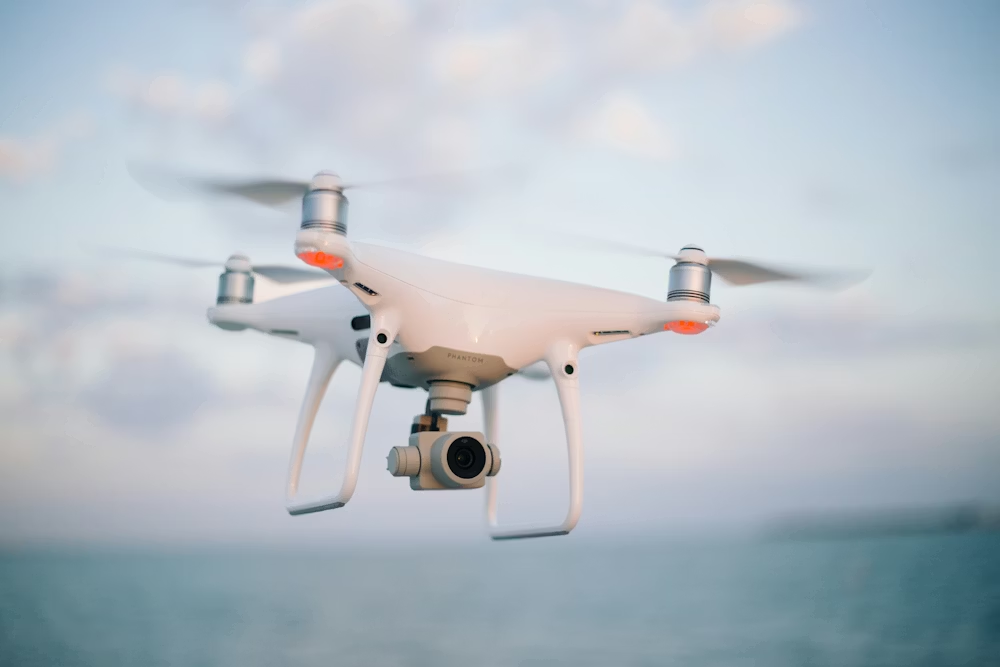
A drone solar panel inspection flies a thermal camera and a high-definition camera over a solar farm or a photovoltaic roof to identify the modules that are not producing normally. Thermal anomalies are detected and then tied to their exact position in the array.
Checking a photovoltaic installation by hand means testing strings one by one, walking between the tables or moving across a roof. It takes time, and a diffuse drop in output easily goes unnoticed. The drone covers the whole array in one flight and brings back a complete thermal map.
A faulty module heats differently from its neighbours: cell hot spots, failed bypass diodes, inactive substrings and soiling show up immediately on the thermal image. Every anomaly is located, so a team can be sent straight to the right place instead of searching.
The protocol is adapted to your installation: ground-mounted plant, solar carports, industrial or commercial roof.
Thermal survey of the whole array, highlighting hot spots, degraded cells and inactive substrings.
Photographic survey of modules and structures: breakage, delamination, soiling, cast shadows, damage to frames and fixings.
Defects reported on a plan of the installation, with table and module references, to send the maintenance team straight to the point.
Visual check of supports, carport structures and anchor points, including areas that are hard to reach.
A commented report of the anomalies found, repeatable from one campaign to the next to track how the plant evolves.
No, quite the opposite: the installation has to be producing for temperature differences to reveal faulty modules.
Sufficient and stable sunshine, moderate wind and a settled sky. We plan the flight slot around these criteria to guarantee usable imagery.
Cell hot spots, failed bypass diodes, inactive substrings, disconnected modules, soiling and shading, as well as visible damage to frames.
No. It targets the areas to check and avoids testing the whole installation blind; electrical measurements are still carried out by your maintenance provider on the identified points.
From a roof of a few hundred square metres to a ground-mounted plant of several hectares, splitting the flight into several sequences where needed.
Four steps, from the first conversation to the delivery of your data.
We define together the perimeter, the accuracy required and the format of the deliverables.
Feasibility study, analysis of site constraints and regulatory procedures.
Our remote pilots operate on site, without interrupting your activity.
Data processing, quality control and delivery of annotated results.
Dronexperts operates across the whole of France. Our professional drone pilots travel to wherever your site is, anywhere in the country, and across Europe for the specific missions our industrial clients require.
Our 5 registered training centres — Paris West (Beynes, 78), Strasbourg (Schiltigheim, 67), Toulouse (Labarthe-sur-Lèze, 31), Marseille/Toulon (Le Castellet, 83) and Bordeaux (Mérignac, 33) — act as anchor points so we can reach every region quickly. They are starting bases, not a limit: we operate throughout France, with the same procedures, the same insurance cover and the same standards from one end of the country to the other.
Our anchor point in Île-de-France: Paris, the inner and outer suburbs and the wider Paris basin.
View the office pageOur Grand Est base: Strasbourg, Colmar, Mulhouse, Metz, Nancy, Reims and the German and Swiss border areas.
View the office pageOur Occitanie base: Toulouse, Montpellier, Albi, Tarbes, Perpignan and the whole South-West.
View the office pageOur Provence-Alpes-Côte d'Azur base: Marseille, Toulon, Aix-en-Provence, Nice and the Mediterranean coast.
View the office pageHead office and historical base of Dronexperts, in Nouvelle-Aquitaine: Bordeaux, La Rochelle, Limoges, Pau, Bayonne.
View the office pageIs your site far from all five centres? That is not a problem: our bases are starting points, not a service perimeter. We organise travel for the team and the equipment anywhere in France, and across Europe for specific missions, on quotation.
Condition of roof coverings, fixings and detailing, documented without any work at height.
Learn moreVolume calculation of bulk material stockpiles by photogrammetry, with figures you can use.
Learn moreDated aerial views, orthophotos and progress comparisons throughout the construction project.
Learn moreInspection of chimney shafts, crowns and equipment on tall structures, with no scaffolding.
Learn morePoint clouds and 3D models of existing buildings, ready for design studies and BIM.
Learn moreInspection of conductors, supports and turbine blades without any access at height.
Learn moreNon-destructive thickness testing of metal walls at height, with no scaffolding.
Learn moreTell us the capacity, the type of installation and its location. We will come back to you with an inspection protocol and a quote.
Become a certified expert and master the skies with our accredited training programs.
Discover
We use cookies to optimize your experience, analyze our traffic, and personalize content. To learn more, see our privacy policy.