
Traveling with Your Drone: Rules in Spain, Belgium, and Europe (2026)
Dronexperts
Company
Is your French remote pilot certification valid in Europe? A practical guide to flying in Spain, Belgium, and the EASA zone without fines. Maps, batteries, and customs: everything you need to know.
Traveling with Your Drone: Regulations in Spain, Belgium, and Europe
Vacation time is approaching, and you’re dreaming of capturing cinematic footage of Spanish beaches, Belgian forests, or Norwegian fjords? It’s every remote pilot's dream.
But beware: crossing a border doesn't mean anything goes. Even though Europe has harmonized its drone rules, each country maintains its own specificities, restricted zone maps, and traps for unwary tourists.
At Dronexperts, we train remote pilots who frequently operate internationally. Here is our 2026 guide to traveling with peace of mind and avoiding having your gear confiscated at customs or dealing with local authorities.
The Big Win: European Harmonization (EASA)
This is the best news of the decade for drone pilots. Since the full implementation of European regulations, the rules of the game are (almost) identical in all EASA member countries (European Union + Switzerland, Norway, Iceland, and Liechtenstein).
This means two essential things for you:
- A Single Certification: Your training certificate obtained in France (A1/A3, A2, or even STS) is valid in all these countries. You do not need to retake an exam in Spanish or German.
- A Single Registration: You only need to register as a "UAS Operator" in one single country (the one where you reside).
- In practice: If you have your French operator number (starting with FRA...) obtained on AlphaTango, DO NOT REGISTER again in Spain or Italy. Your FRA number is recognized everywhere. Simply stick it onto your drone.
Focus on Belgium: Watch the Density
Belgium is a beautiful but complex country for drones due to its high population density and busy airspace.
- Reference Map: Do not use the French Géoportail! You must consult the official Belgian map via the SkeyDrone tool or the Droneguide.be website.
- The Traps: Belgium has numerous CTRs (Airport Control Zones) and port areas (Antwerp) that are strictly prohibited or require prior authorizations.
- Insurance: Check your contract. Aviation civil liability insurance is mandatory.
Focus on Spain: The National Park Trap
Spain is a top destination, but it is very strict regarding environmental protection.
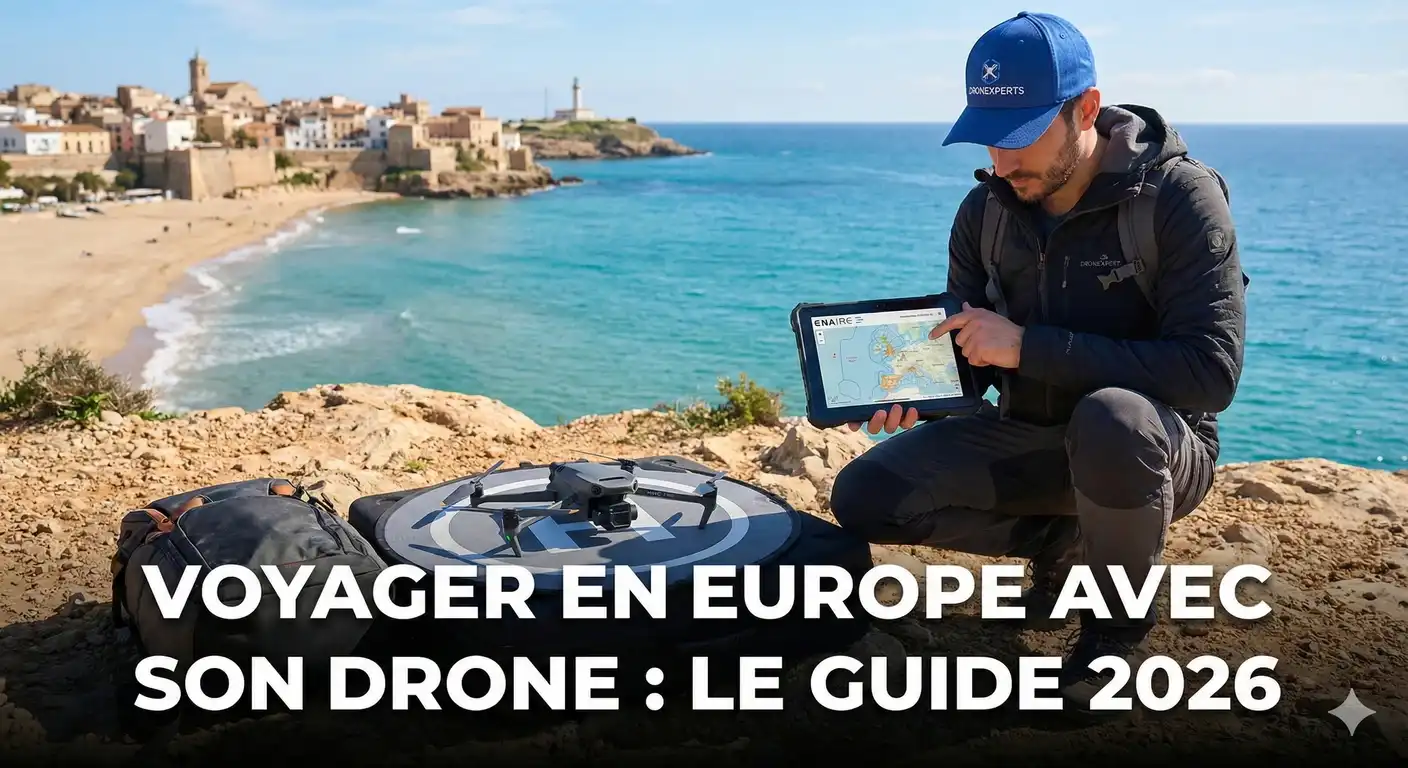
- Reference Map: The official tool is ENAIRE Drones (drones.enaire.es). It is the only reliable source.
- The Big Trap: ZEPA Zones. In Spain, vast territories are classified as ZEPA (Special Protection Areas for Birds) or National Parks. Overflying these areas is generally prohibited for leisure drones without explicit authorization from the park management body. Fines for disturbing wildlife can reach several thousand euros.
- Cities and Beaches: As in France, flying over urban areas and crowded beaches is prohibited in the Open category. Don't fly over the Sagrada Família!
And Outside of Europe? (Morocco, USA, UK...)
As soon as you leave the EASA zone, your French certifications are worth little to nothing, and the rules change radically.
🔴 Morocco: Leave the Drone at Home
This is a question we get every week. Importing drones into Morocco is strictly prohibited without an import authorization that is extremely difficult to obtain. If you try to pass through customs with your drone in your suitcase, it will be systematically confiscated at the airport. You might (maybe) get it back upon departure by paying storage fees, but your vacation will be drone-free.
🔵 The United States (USA)
It is simpler, but administrative.
- You must pass a short, free online exam called The TRUST Test.
- You must register your drone on the FAA (Federal Aviation Administration) website for a few dollars.
⚪ The United Kingdom (UK)
Since Brexit, the UK is no longer part of EASA. They often recognize similar rules, but you must obtain a specific UK Operator ID from the CAA (Civil Aviation Authority) before flying.
3 Expert Tips Before Packing Your Bags
To prevent your dream trip from turning into a nightmare, follow this Dronexperts checklist:
- LiPo Batteries in CABIN ONLY: This is an international aviation safety rule. Lithium batteries must never travel in checked luggage (fire risk). Keep them with you in your carry-on, ideally in fireproof bags (LiPo Safe Bags), and protect the connectors.
- Print Your Documents: In case of a check by a local officer who doesn't speak your language, having a paper version of your A1/A3 certificate (often available in English on AlphaTango) and your proof of insurance will make the dialogue much easier.
- Respect the Locals: Abroad, you are an ambassador for the remote pilot community. Do not fly near historical monuments and respect the tranquility of the surroundings. Exemplary behavior prevents laws from becoming even more restrictive.
Conclusion
Traveling with your drone is a wonderful experience that allows you to bring home unique memories. Europe makes things much easier, but flight preparation (checking local maps) remains the pilot's responsibility.
Don't feel technically confident enough to fly in unfamiliar environments? Come and perfect your skills with our practical training courses before you depart.
[👉 Discover Dronexperts advanced training courses]
Cookie Settings
We use cookies to optimize your experience, analyze our traffic, and personalize content. To learn more, see our privacy policy.