
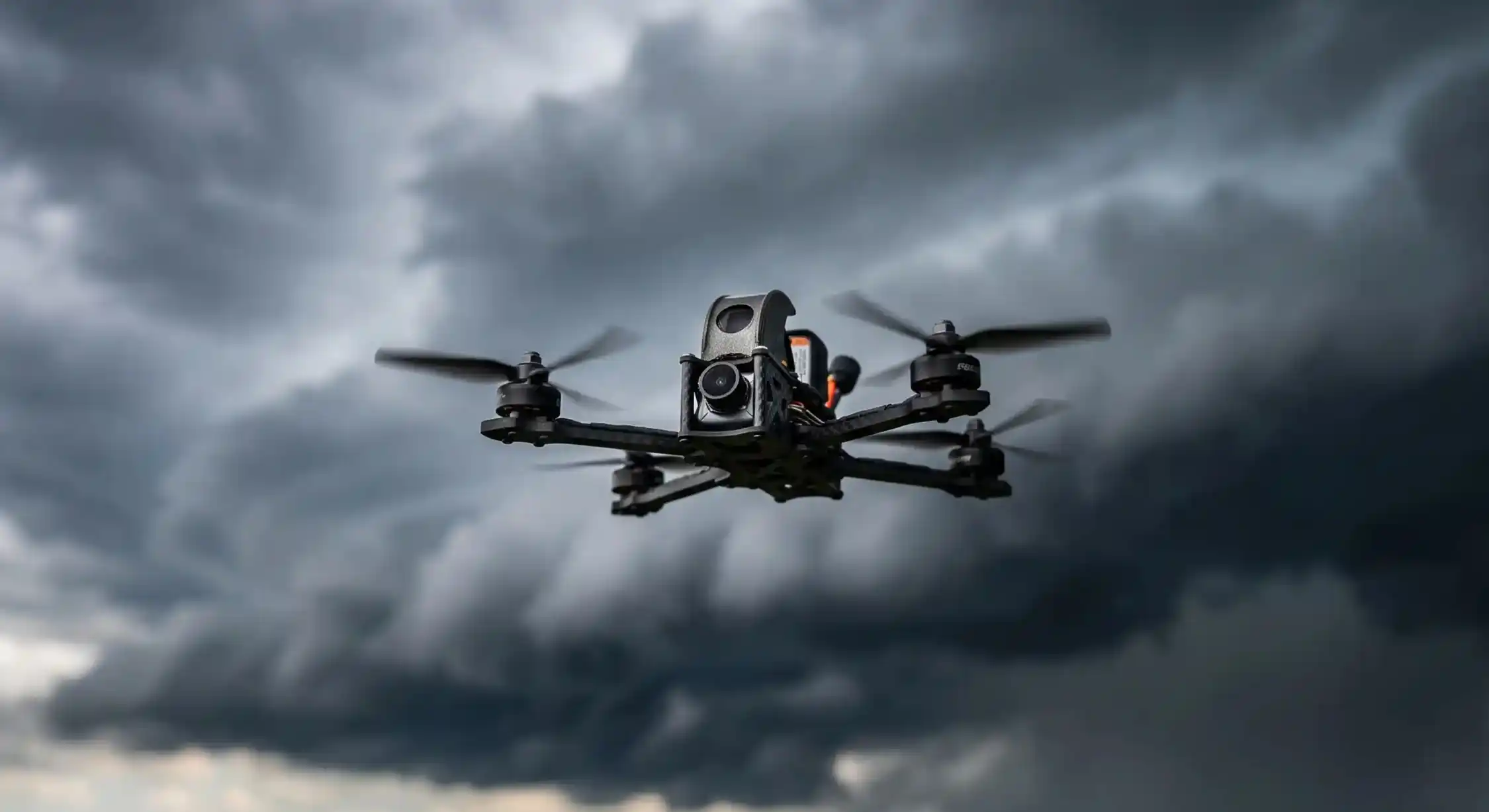
OTUS Project: This FPV Drone Filmed Inside a Tornado in 360°
Dronexperts
Company
An FPV drone fitted with a 360° camera filmed inside a tornado for the first time ever. Discover the OTUS Project — a technical and scientific breakthrough.
Some footage changes everything. In late April 2026, a video spread across social media and news channels worldwide: an FPV drone filming the inside of a tornado in real time — in 360°, with a level of precision and immersion never seen before. Behind this feat: a handful of passionate students and engineers known as The OTUS Project. A name worth remembering.
OTUS: Drones at the Heart of the Storm
OTUS stands for Observations of Tornadoes by UAV Systems. The project was born in February 2024, from a simple midnight phone call between three friends with complementary skill sets.
- Nelson Tucker, a meteorology student at Millersville University, fascinated by tornadoes since childhood.
- Louis Tucker, his older brother, 2023 National Collegiate Drone Racing Champion and designer of high-performance FPV systems.
- Tanner Beard, an aerospace engineer specializing in additive manufacturing and extreme quad builds.
Less than three months after that conversation, Louis Tucker piloted the first drone to penetrate a multi-vortex tornado while maintaining full control of the aircraft — a feat the scientific community had never witnessed before.
A Rapid Progression: From 2024 to 2026
Since that historic first flight in May 2024, the team has not slowed down.
In 2025, the project scaled dramatically: 8 tornadoes intercepted, 11 documented drone penetrations, with high-resolution thermodynamic data and flight telemetry captured across multiple events. A partnership was established with the NIST (National Institute of Standards and Technology), through which Nelson Tucker developed — during a research fellowship — an omnidirectional wind sensor capable of measuring the vertical component of tornado-force winds. Until then, that had been one of the great unsolved challenges in storm science.
For 2026, the ambition is even greater: more than 20 drone intercepts are planned over an 8-week field campaign. A custom mobile command vehicle, equipped with satellite connectivity, redundant power systems, and integrated wireless drone networks, now accompanies the team into the field.
The April 2026 Milestone: A 360° Camera Enters the Tornado
This time, an even more advanced prototype drone was deployed. Fitted with a 360° camera and thermal sensors, the aircraft penetrated what the team itself described as a "small" tornado — a successful test run ahead of far more intense missions to come.
The result is striking. "It was pretty surreal. I'd never seen a tornado with so many different kinds of rings in it," said Louis Tucker. The footage, shared widely on social media and picked up by major TV networks, represents the first time a 360° camera has ever captured the inside of a tornado, delivering a fully immersive view of the phenomenon that was simply impossible before.
But beyond the visuals, the data collected is invaluable: temperature, pressure, humidity, and — for the first time — experimental measurements of 3D wind forces inside the rotating column.
Drones That Could Save Lives
The stakes go well beyond technological performance. Every year, the United States records several hundred tornadoes on average, responsible for dozens of deaths and billions of dollars in damage. The internal dynamics of these storms remain poorly understood — precisely because, until now, it was impossible to send measuring instruments inside them without risking human lives.
The Federal Aviation Administration (FAA) recognized the value of this approach and granted the OTUS team an official waiver to conduct operations in and around tornadoes — a first in U.S. aviation history for this type of mission.
According to the team, the data collected could feed artificial intelligence models capable of improving early warning systems, potentially providing several additional minutes of advance notice to at-risk communities — a margin that can be measured in lives saved.
Conclusion: The FPV Drone as a Scientific Tool
The OTUS Project perfectly illustrates how FPV culture — born in garages and on racing circuits — can be put to work for the most demanding scientific research. 3D-printed drones, piloted by a racing champion, at the heart of the planet's most violent tornadoes: it's hard to imagine a better ambassador for the true capabilities of advanced FPV flight.
The 2026 storm season is only just beginning. The OTUS team is preparing its next 20 intercepts. And somewhere above the American Great Plains, an FPV drone is getting ready to fly into the storm once more.
Cookie Settings
We use cookies to optimize your experience, analyze our traffic, and personalize content. To learn more, see our privacy policy.