
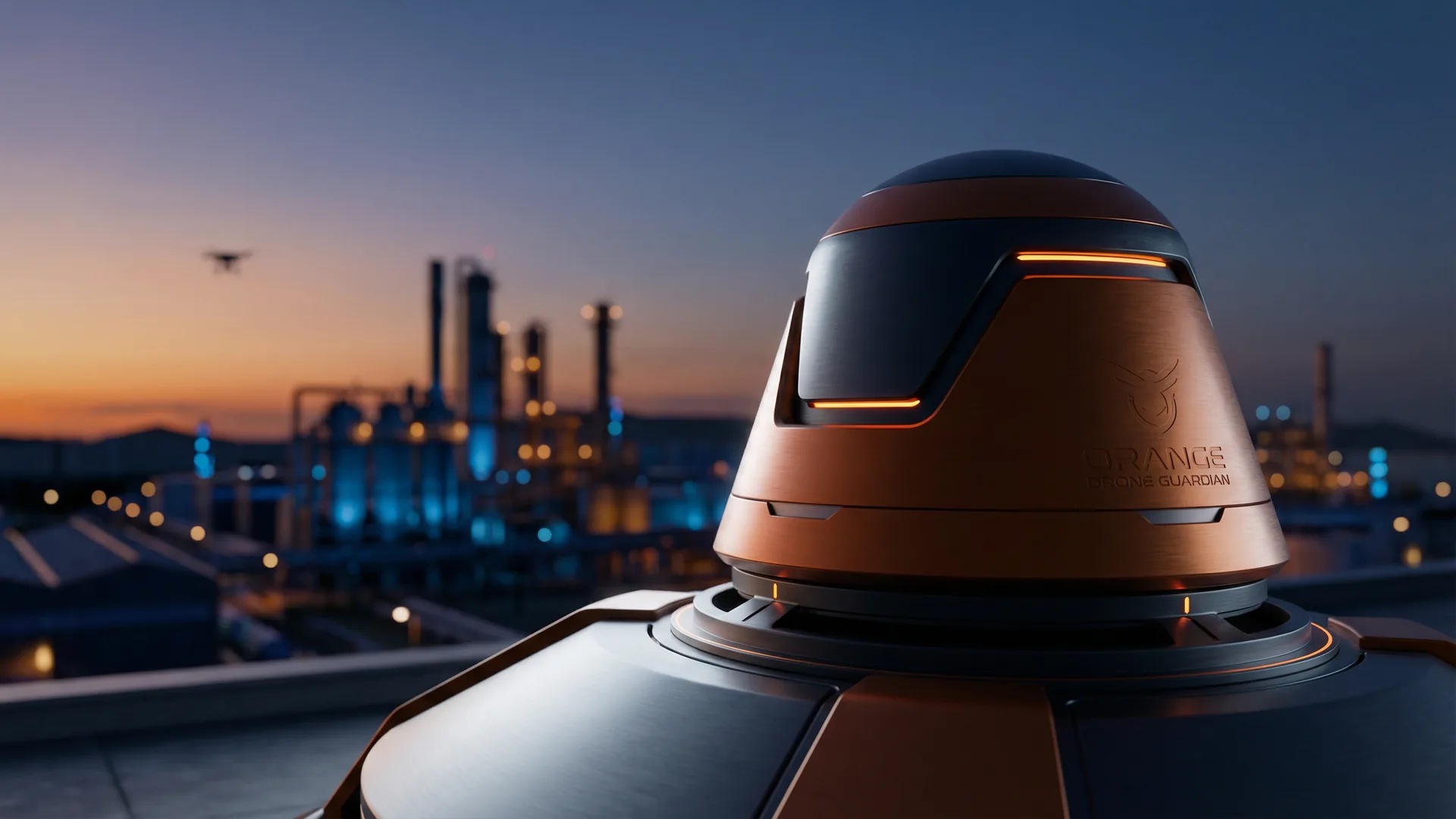
Orange Drone Guardian: Anti-Drone as-a-Service in France
Dronexperts
Company
Discover Orange Drone Guardian, the new anti-drone as-a-service solution from Orange Business. Sovereign protection for critical infrastructure.
In the face of the proliferation of civilian drones and the rise of malicious use cases, securing low-altitude airspace has become an absolute priority. In 2025, major European airports such as Berlin, Amsterdam, and Brussels were repeatedly disrupted by unidentified drone intrusions. In France, flyovers of sensitive military bases, including the Île Longue nuclear submarine base, highlighted the vulnerability of critical infrastructure. It is within this tense context that Orange Business made a significant move during the Orange Business Summit 2026, on March 17, 2026, by unveiling Orange Drone Guardian. This innovative Counter-Unmanned Aircraft System (C-UAS) solution, offered as-a-Service, promises to transform the protection of sensitive sites in France and, eventually, across Europe.
A Sovereign Architecture Built on Telecom Infrastructure
The true strength of Orange Drone Guardian lies not only in its sensors but in the global architecture that supports it. Unlike traditional systems that require heavy and costly deployments for each individual site, this solution leverages the incumbent operator's existing network.
Orange utilizes the exceptional territorial grid of TOTEM, its TowerCo, which manages over 19,700 sites across France. Telecom towers and rooftops are thus transformed into strategic high points for the installation of detection sensors. This approach provides extensive coverage and an optimized line of sight, which is particularly crucial in dense urban environments where electromagnetic interference and structural obstacles complicate detection. For clients, the advantage is considerable: they no longer need to deploy and maintain their own sensor network, drastically reducing both costs and implementation timelines.
Secure and Centralized Data Processing
Detection is only useful if the information is processed quickly and securely. Orange Drone Guardian integrates a comprehensive Command and Control (C2) chain. Sensor data travels via Orange's resilient and fully managed connectivity across the entire country. Processing is then carried out on Cloud Avenue SecNum, a platform qualified as SecNumCloud 3.2 by ANSSI, hosted in an eco-responsible data center in Grenoble. This qualification is an essential guarantee of digital sovereignty for data as sensitive as airspace surveillance. Finally, a secure operations center located in France and staffed by experts consolidates and analyzes information in real-time to provide a clear operational picture.
Who Is Orange Drone Guardian For?
This solution for detecting, identifying, and classifying intrusive drones specifically targets actors with critical security needs. It meets the requirements of Operators of Vital Importance (OIV) and Operators of Essential Services (OSE), major event organizers, and public institutions responsible for protecting sensitive infrastructure. Specifically, the covered use cases are numerous: industrial and logistics sites, ports and airports, dense urban areas, and mass events such as international sporting competitions.
The advantage of the "as-a-Service" model is its operational and financial flexibility. Clients benefit from real-time surveillance without having to bear the heavy initial investments (CAPEX) associated with purchasing and maintaining a proprietary sensor network. The solution adapts to each client's specific context, making it a particularly relevant tool for one-off needs, such as securing an event, or permanent ones, such as protecting a nuclear site.
Scalability and Technological Outlook
While the exact nature of the current sensors has not been fully detailed by Orange Business, the operator emphasizes the open architecture of its solution. Orange Drone Guardian is designed to evolve and integrate new software modules and sensor types over time.
The future integration of Artificial Intelligence (IA) and Digital Twins will further refine data analysis and allow for the precise modeling of protection zones, blind spots, and probable approach corridors. Even more promisingly, the solution plans to integrate radio detection technologies enabled by 5G networks, specifically ISAC (Integrated Sensing and Communication). This technology, already being explored by players like Ericsson, allows the communication infrastructure itself to be transformed into a vast network of passive sensors capable of detecting and geolocating flying objects without the need for additional dedicated hardware.
Conclusion: A Turning Point for Critical Infrastructure Security
With the launch of Orange Drone Guardian, less than a year after the creation of its Defense & Security division in June 2025, Orange Business demonstrates how a national digital infrastructure can be converted into a sovereign security capability. In a rapidly expanding European anti-drone market—estimated to reach $4.16 billion by 2030 according to MarketsandMarkets—this networked approach offers a pragmatic and scalable response to a growing threat.
For drone professionals, this announcement is a strong signal: low-altitude airspace is now at the heart of national security challenges. The ability to detect threats earlier and organize a coordinated response before a simple drone turns into a major strategic incident is now a necessity. Orange Drone Guardian lays the foundation for a sovereign, scalable, and shared aerial surveillance ecosystem that could well redefine anti-drone standards in Europe.
Cookie Settings
We use cookies to optimize your experience, analyze our traffic, and personalize content. To learn more, see our privacy policy.