
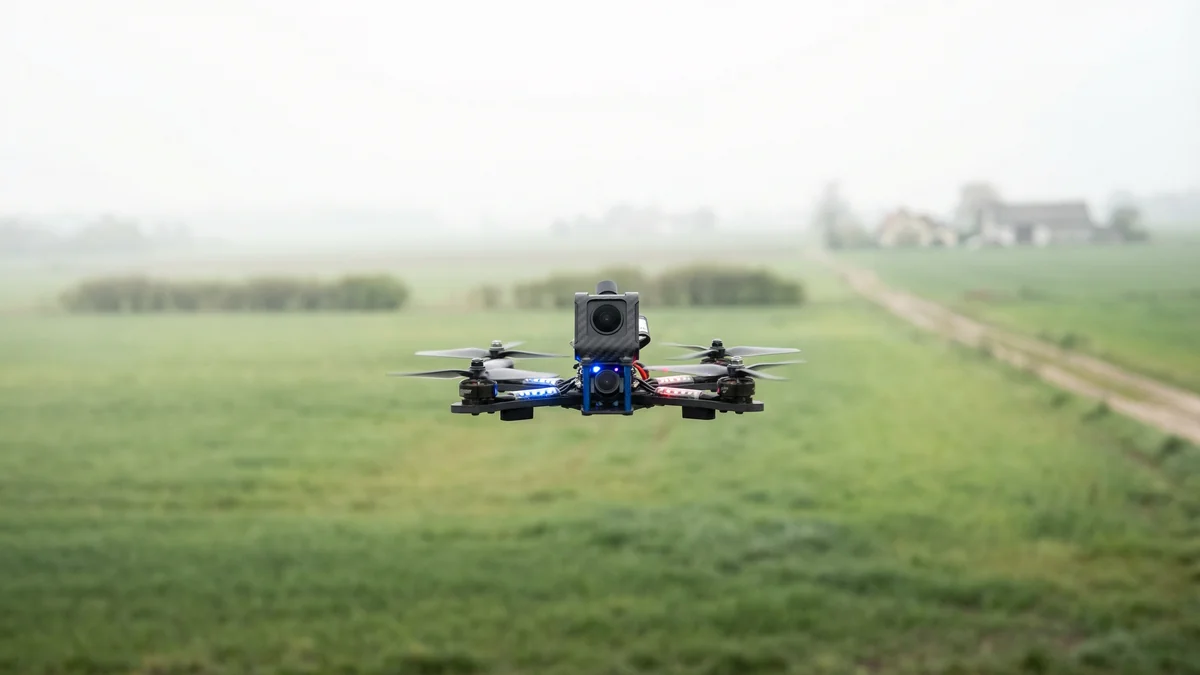
FPV Flight Without an Observer: Poland Leads the Way
Dronexperts
Company
Poland authorizes FPV flights without a visual observer in 2026. Discover the conditions of this exemption and its impact on French and European pilots.
The requirement to be accompanied by a visual observer during a First Person View (FPV) flight is arguably the most debated and—let’s face it—most widely bypassed rule in the remote pilot community. While European Regulation (EU) 2019/947 mandates that drones be kept within Visual Line of Sight (VLOS), an unexpected opening has just emerged. In 2026, the Polish Civil Aviation Authority (ULC) officially launched a groundbreaking trial: authorizing FPV flights without a visual observer. This pragmatic decision could very well set a major precedent for all European Union member states, including France.
The Structural Paradox of FPV Flight vs. the Law
Since the implementation of European drone regulations, the legal framework for FPV flight has relied on a complex compromise. Because wearing FPV goggles inherently breaks direct visual contact with the aircraft, the law requires an observer to stand beside the pilot. Their role is to scan the airspace and warn the remote pilot of any imminent danger. In the Open category, this observer does not need to be registered as a UAS operator or have specific training. However, in the Specific category, requirements are far more stringent: the observer must satisfy all the same regulatory obligations as the pilot, including registration, training, and insurance.
Yet, the reality on the ground is quite different. The Polish authorities made a lucid observation in their official decision (reference LBSP.503.1.2026.ULC.1): the availability of lightweight, technologically advanced drones has led to massive FPV activity occurring outside the regulatory framework. The practical difficulty of mobilizing a dedicated observer for every flight session creates a gaping chasm between legal requirements and the actual operational needs of the community. This observation is not unique to Poland: the situation is identical in France, Germany, Italy, and Spain.
Faced with this structural incompatibility—particularly evident during freestyle flights where agile drones operate at low altitudes and high speeds—Poland has chosen a pragmatic approach over blind enforcement.
The Strict Conditions of the Polish Trial
Far from being a total deregulation, the Polish initiative is based on Article 71 of the European Regulation (EU) 2018/1139. This text allows Member States to grant temporary and proportionate exemptions in cases of proven operational need, subject to a rigorous risk assessment. The ULC conducted this assessment for subcategories A1, A2, and A3 and concluded that, given the weight, altitude, and distance constraints already in place, a limited exemption from the VLOS requirement is justifiable.
Valid from February 12 to October 12, 2026, this exemption (designated LBSP/SPEC/O/2026-04) applies to the Open category but imposes strict limits to ensure safety:
| Subcategory | Drone Class | Max Horizontal Distance | Max Altitude |
|---|---|---|---|
| A1 | C0, C1 or private build < 250g | 200 m | 50 m AGL |
| A2 | C2 up to 4 kg | 200 m | 50 m AGL |
| A3 | C3 up to 4 kg | 500 m | 50 m AGL |
For subcategory A3, an additional constraint applies: the drone must maintain a horizontal distance of at least 150 meters from any residential, commercial, industrial, or recreational area. Furthermore, the exemption does not waive any other regulatory obligations, such as pilot certifications, no-fly zones, remote identification, etc.
The universal 50-meter AGL ceiling was not chosen at random. It perfectly matches the typical flight profile of FPV freestyle and racing, which mostly takes place near the ground or obstacles. Anyone practicing proximity flying or "power-looping" arches is already operating well below this ceiling.
What Impact for French and European Pilots?
This eight-month trial will be closely monitored by the European Union Aviation Safety Agency (EASA) and national authorities like the DGAC in France. The Polish ULC's objective is explicit: to collect real-world incident data over a sufficient period to draw reliable conclusions. If, at the end of this period, no significant increase in accidents is recorded, this data will serve as a powerful argument for a permanent amendment to European Regulation 2019/947.
This precedent is even more significant given that the Milano-Cortina 2026 Winter Olympics provided global visibility to FPV. For the first time in Olympic history, FPV drones were deployed at several sites to offer viewers unprecedented immersive footage, following athletes at close range. This massive media exposure has bolstered the discipline's legitimacy in the eyes of the general public and policymakers alike.
For French pilots, who are currently forced to fly illegally if they practice alone, this initiative represents a huge beacon of hope. It demonstrates that there is a legal path to adapting regulations to technological reality without sacrificing public safety. Every Member State has the same legal tool (Article 71) and could use it to launch their own trials before the end of the year.
Conclusion: Toward Truly Adapted FPV Regulations?
Poland's initiative marks a decisive turning point in the history of drone legislation in Europe. By officially recognizing that the visual observer rule is ill-suited to modern FPV practice, Polish authorities are paving the way for smarter, more respected, and more effective regulation.
It remains to be seen whether EASA will seize this opportunity to modernize Regulation 2019/947 during its next revision. In the meantime, French remote pilots must continue to comply with current legislation while keeping a close eye on the results of this experiment. One thing is certain: Poland has just proven that regulatory stagnation is not inevitable, and that authorities can choose to listen to their communities rather than ignore them.
Cookie Settings
We use cookies to optimize your experience, analyze our traffic, and personalize content. To learn more, see our privacy policy.