
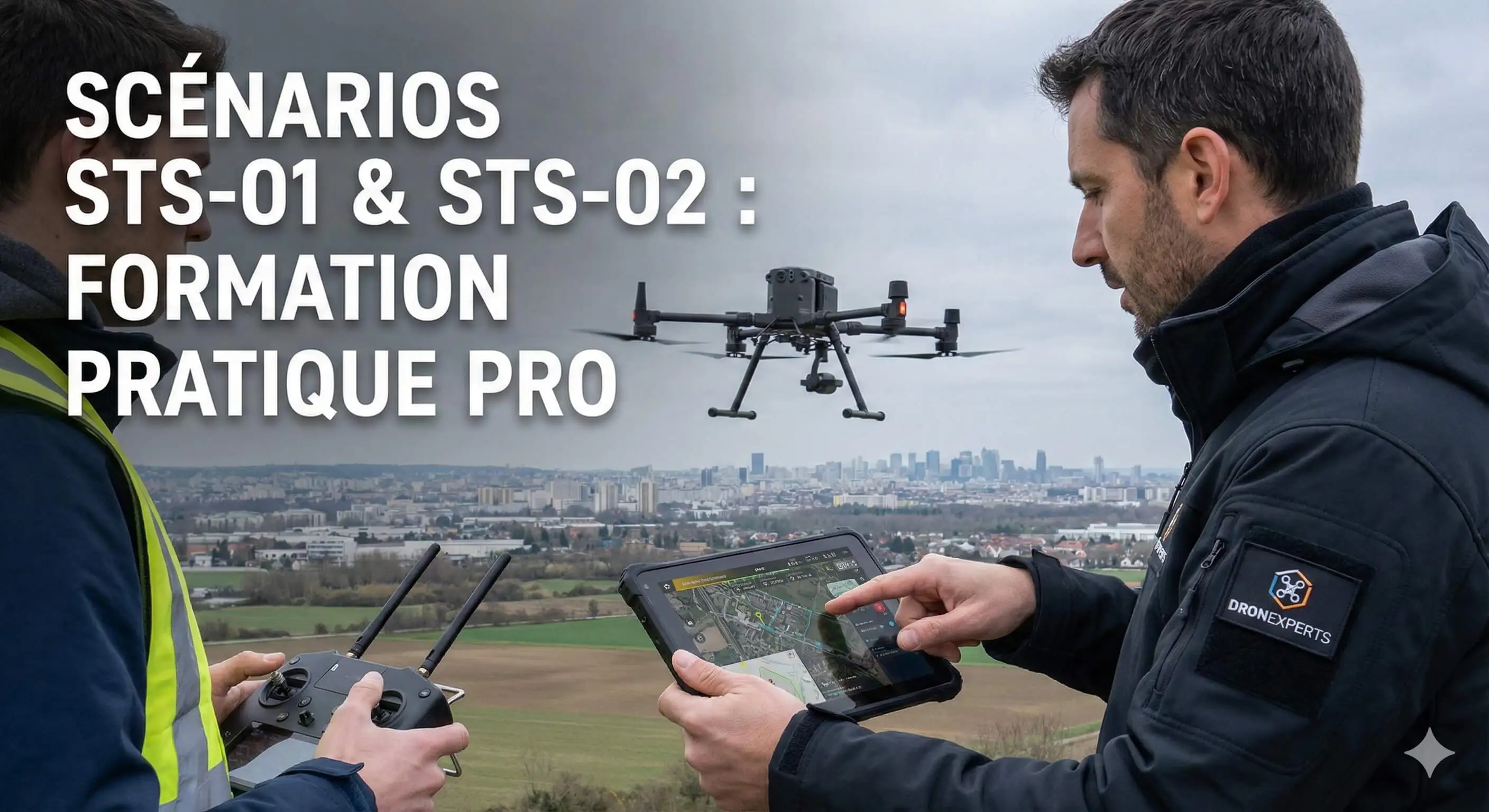
European Standard Scenarios STS-01 and STS-02: The Complete 2026 Guide
Dronexperts
Company
STS-01 (urban visual line of sight) and STS-02 (beyond visual line of sight). Understand the Specific category, C5/C6 drones, and how to validate your practical training with Dronexperts.
European Standard Scenarios STS-01 and STS-02: Understanding Everything
If you are considering a career as a professional remote pilot in 2026, you can (almost) forget everything you’ve heard about the old French S1, S2, and S3 scenarios. European harmonization has taken over, and the Specific Category now has its own set of rules: the Standard Scenarios (STS).
For newcomers to the market, this is the only path to complex missions such as urban operations or beyond visual line of sight flights. However, these new standards impose strict hardware requirements and demand rigorous practical training.
At Dronexperts, we are authorized to provide this practical training. Let’s decode exactly what lies behind the acronyms STS-01 and STS-02.
The End of S1, S2, S3... Make Way for Europe
For years, France operated under its own national scenarios. Since 2024, the transition has been finalized for new operators. Now, to operate in the "Specific" category (meaning for moderate-risk operations that do not fall under the Open category), you must comply with European standards.
The advantage? Your qualification is valid throughout the European Union. The downside? You must master two new key scenarios.
STS-01 Scenario: The Standard for Urban Operations (VLOS)
STS-01 is the worthy successor to the old S3. This is the scenario you will use for 80% of audiovisual or inspection missions in cities.
- The Principle: Flight within the pilot's direct line of sight (VLOS - Visual Line of Sight).
- Environment: Controlled ground area in a populated (urban) environment.
- Max Height: 120 meters.
- Max Speed: 5 m/s (approximately 19 km/h).
Hardware Requirement: The Class C5 Drone This is the major change. To fly under STS-01, you cannot use just any drone. You must use an aircraft with a Class C5 identification label (or a C3 drone equipped with a certified C5 conversion kit). These drones are equipped with Flight Termination Systems (FTS) and specific low-speed modes to ensure the safety of third parties.
Dronexperts Tip: If you want to perform roof inspections or real estate reporting in the city, this is the essential scenario to validate.
STS-02 Scenario: Going Further (BVLOS)
STS-02 replaces the old S2. It is intended for technical missions over large areas.
- The Principle: Flight Beyond Visual Line of Sight (BVLOS). The pilot no longer sees the drone and flies using instruments or with the help of airspace observers.
- Max Distance: Up to 1 km from the pilot (if no observer is present) or up to 2 km (with observers).
- Environment: Controlled ground area in a sparsely populated environment.
- Max Height: 120 meters.
Hardware Requirement: The Class C6 Drone STS-02 requires a Class C6 drone. These machines are even more advanced in terms of data links (C2 Link) and geographic position management to ensure safety when the pilot cannot see the aircraft.
Typical Applications: Agricultural surveillance, power line inspection, large-scale quarry photogrammetry, and search and rescue.
How to Validate Your STS Practical Training?
Unlike the Open category, where everything takes place online, the Specific category requires true piloting proficiency.
To operate under STS, the path is as follows:
- Theory: Obtain the CATS (Remote Pilot Theoretical Knowledge Certificate for Standard Scenarios) via an exam at a DGAC center (40-question multiple-choice test) or online.
- Practice: This is where Dronexperts comes in.
Practical training is no longer conducted before a DGAC examiner. Regulations entrust this responsibility to Declared Operators and Training Centers (like us).
At Dronexperts, practical validation includes:
- Mastering flight preparation (planning, ground zone setup, risk analysis).
- Normal procedures (takeoff, precision hovering, specific flight paths).
- Emergency procedures (managing engine failure, zone intrusion, loss of C2 link).
Upon completion of the training and following a successful evaluation, we issue a Practical Training Certificate. This document, signed by our center, proves your ability to operate under STS-01 or STS-02.
Conclusion: Don't Neglect the Practice
STS scenarios are the gateway to the professional drone world. They require rigor and appropriate equipment (C5/C6).
Do not navigate this regulatory complexity alone. A misinterpretation of the texts or a handling error during an urban flight can have serious consequences.
Dronexperts is authorized to train you and issue the practical STS certificate required for your business.
[👉 Check the dates for our upcoming STS Practical training sessions]
Cookie Settings
We use cookies to optimize your experience, analyze our traffic, and personalize content. To learn more, see our privacy policy.