
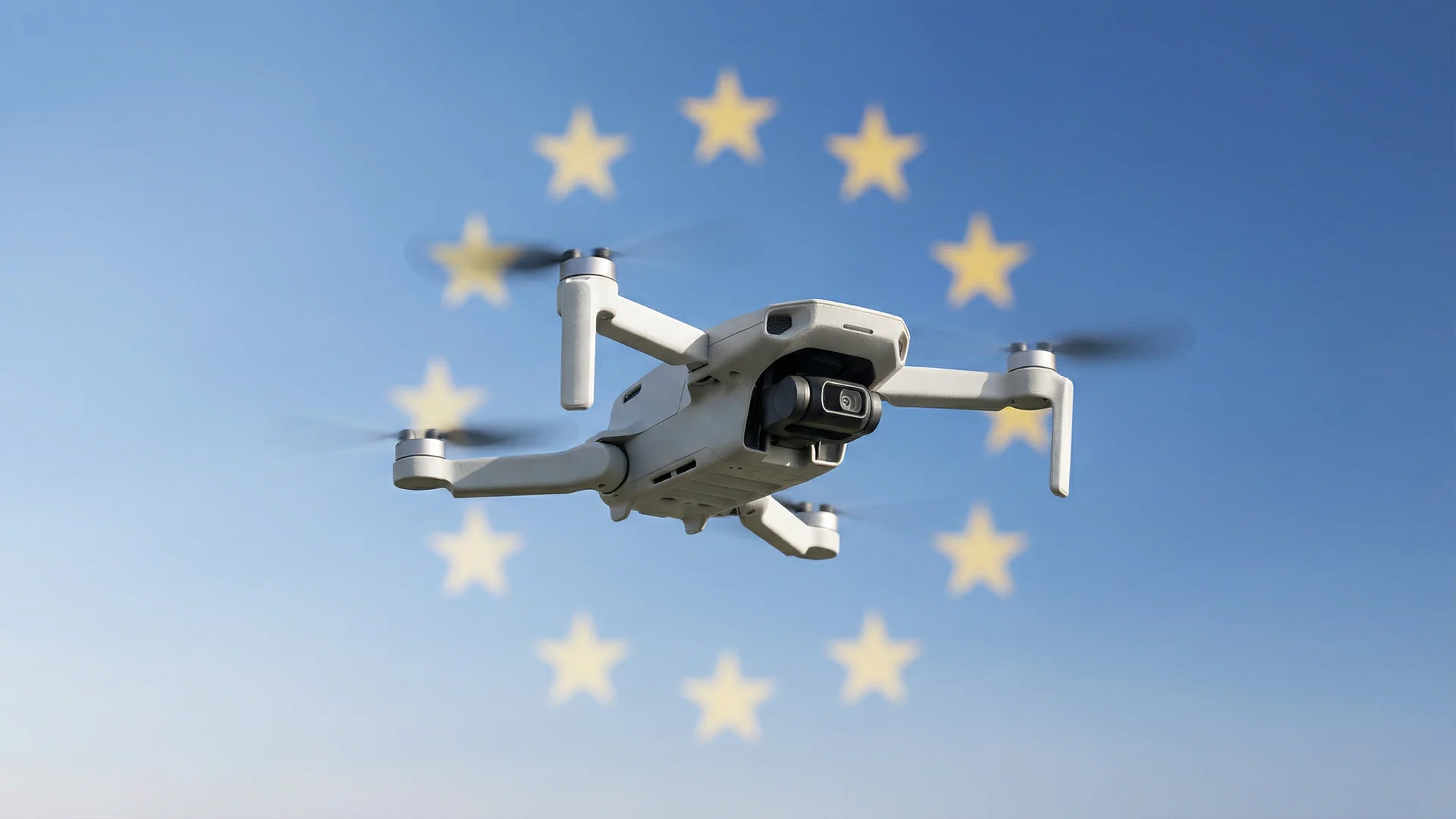
European Drone Regulations: The 100g Threshold Will Change Everything
Dronexperts
Company
The European Commission is lowering the drone registration threshold to 100g starting in 2026. What this means in practice for all European pilots.
On February 11, 2026, during a press conference in Strasbourg, the European Commission presented its Action Plan on Drone Security and Counter-UAS Systems (COM(2026) 81 final). Tucked away behind anti-intrusion measures and new detection technologies is a provision that will disrupt the lives of millions of European pilots: the lowering of the mandatory registration threshold from 250 grams to 100 grams. This regulatory revolution is set to be implemented as early as the third quarter of 2026.
Why Europe Decided to Act Now
The summer and autumn of 2025 marked a turning point in how drones are perceived in Europe. An unprecedented wave of incidents highlighted glaring gaps in the aerial surveillance framework. The Danish airports of Aalborg and Billund were forced to close following unexplained nocturnal flyovers. Copenhagen and Oslo suffered disruptions lasting several hours. Munich saw its air traffic interrupted twice within 48 hours. More recently, in late February 2026, an unidentified drone was neutralized near the aircraft carrier Charles de Gaulle during a port call in Sweden.
These incidents share a disturbing commonality: the almost total absence of successful investigations. Authorities were unable to identify the aircraft, their operators, or their intentions. This is precisely the void the Action Plan seeks to fill. As Executive Vice-President of the Commission Henna Virkkunen stated: "This malicious or irresponsible use of drones affects the protection of critical infrastructure, our external borders, ports, transport hubs, and public spaces."
The Drone Security Package: Practical Changes for Pilots
The heart of the plan lies in a Drone Security Package that the Commission intends to submit for approval before the end of Q3 2026. This regulatory package introduces four major changes that directly affect both hobbyists and professional operators.
| Requirement | Current Threshold | New Proposed Threshold |
|---|---|---|
| Operator Registration | > 250g (or any drone with a camera) | > 100g |
| Direct Remote Identification (DRI) | Classes C1, C2, C3, C5, C6 | All drones > 100g |
| Pre-flight Operator ID Entry | Not mandatory | Mandatory |
| Geo-awareness | Classes C1, C2, C3, C5, C6 | All drones > 100g (under consideration) |
The impact is massive. With 1.6 million drone operators already registered in Europe according to EASA, this figure could explode. Devices previously exempt from registration—such as the HoverAir X1 (125 grams), almost all racing FPV drones, and micro photography drones—would now fall under the regulatory umbrella. The UK, which already took this step in January 2026, acts as a precursor: any pilot flying an aircraft of 100 grams or more there must now obtain a Flyer ID via an online theoretical test.
The question of drones built before January 1, 2024, and DIY (Do-It-Yourself) aircraft remains. Making these machines compliant with Direct Remote ID requirements is technically difficult, if not impossible in some cases. Will they be exempt, risking making the measure pointless, or simply banned from flight?
5G as Radar: ISAC Technology at the Heart of the System
Beyond regulations, the Action Plan bets on ambitious technological innovation to detect malicious drones: transforming 5G antennas into passive radar sensors. This approach relies on ISAC (Integrated Sensing and Communication) technology, which exploits the radio signals of mobile networks to detect and locate flying objects, including non-connected drones.
Europe currently has 351,600 5G base stations, a potentially massive grid for low-altitude airspace surveillance. The principle is ingenious: radio waves emitted by the antennas reflect off surrounding objects, and AI-driven analysis identifies the characteristic signature of a drone. Ericsson demonstrated the viability of this technology in late February 2026 during a demo in Texas, proving that massive-MIMO 5G radios can detect and track passive drones using existing network infrastructure.
The Commission plans to launch a call for projects among Member States and the industry to deploy real-world 5G detection tests. In theory, every cell tower would become a node in a distributed surveillance network. In practice, the challenge remains: distinguishing a drone from a bird at a distance is an engineering problem that no one has yet solved satisfactorily.
A Difficult Balance Between Security and Freedom of Flight
The Action Plan raises a fundamental question that the pilot community is vehemently asking: Are these measures truly targeting the right actors? Pilots engaging in malicious flights will never register as UAS operators, will not display their ID numbers on their aircraft, and will use modified drones to bypass detection systems. It is the law-abiding pilots—already registered, already trained—who will bear the brunt of the additional administrative burden.
The Commission seems aware of this. The plan also includes regulatory simplifications for certain operations, though the details have yet to be specified. It also integrates the creation of an "EU Trusted Drone" label by the end of 2026, intended to identify secure equipment on the market and protect supply chains against risky components—a measure implicitly targeting dominant manufacturers whose electronic components are subject to reinforced security assessments.
The European drone market is at stake. According to the Commission’s Drone Strategy 2.0, it could reach €14.5 billion by 2030 and generate 145,000 jobs. A regulatory framework that is too restrictive risks stifling innovation and discouraging legitimate uses—precision agriculture, infrastructure inspection, delivery, aerial cinematography—at the very moment Europe seeks to build a competitive drone industry against American and Asian players.
Key Takeaways and What to Watch
The timeline is tight. The Drone Security Package must be ready for Q3 2026, less than six months away. Discussions with Member States, industry, and the European Parliament will intensify in the coming weeks. Several milestones deserve close attention: the launch of the D-TECT industrial forum in Q2 2026, the publication of the EU Trusted Drone label in Q4 2026, and the opening of the Counter-Drone Center of Excellence in Geel, Belgium, in Q1 2027.
For drone pilots, now is the time for vigilance. If the 100-gram threshold is confirmed, you will need to register as a UAS operator, equip your aircraft with a functional Direct Remote ID system, and comply with geo-awareness requirements—even for a 120-gram FPV nano-drone. The drone community would be wise to participate actively in the upcoming public consultations to ensure its voice is heard in the final drafting of the text.
Cookie Settings
We use cookies to optimize your experience, analyze our traffic, and personalize content. To learn more, see our privacy policy.