
Drones and 5G: How Ericsson's ISAC Technology Changes the Game
Dronexperts
Company
5G as an anti-drone radar: Ericsson proves that ISAC technology can detect passive drones in real-time. Explore the mechanics, challenges, and future outlook.
The proliferation of civilian and commercial drones presents unprecedented security challenges, particularly for critical infrastructure. In response to the rise of unauthorized flyovers, the telecommunications industry is offering an innovative solution: transforming existing mobile networks into detection shields. Recently, Ericsson reached a decisive milestone by demonstrating the effectiveness of ISAC (Integrated Sensing and Communication) technology using its 5G equipment, paving the way for a new era in counter-drone defense.
ISAC Technology: When 5G Becomes Precision Radar
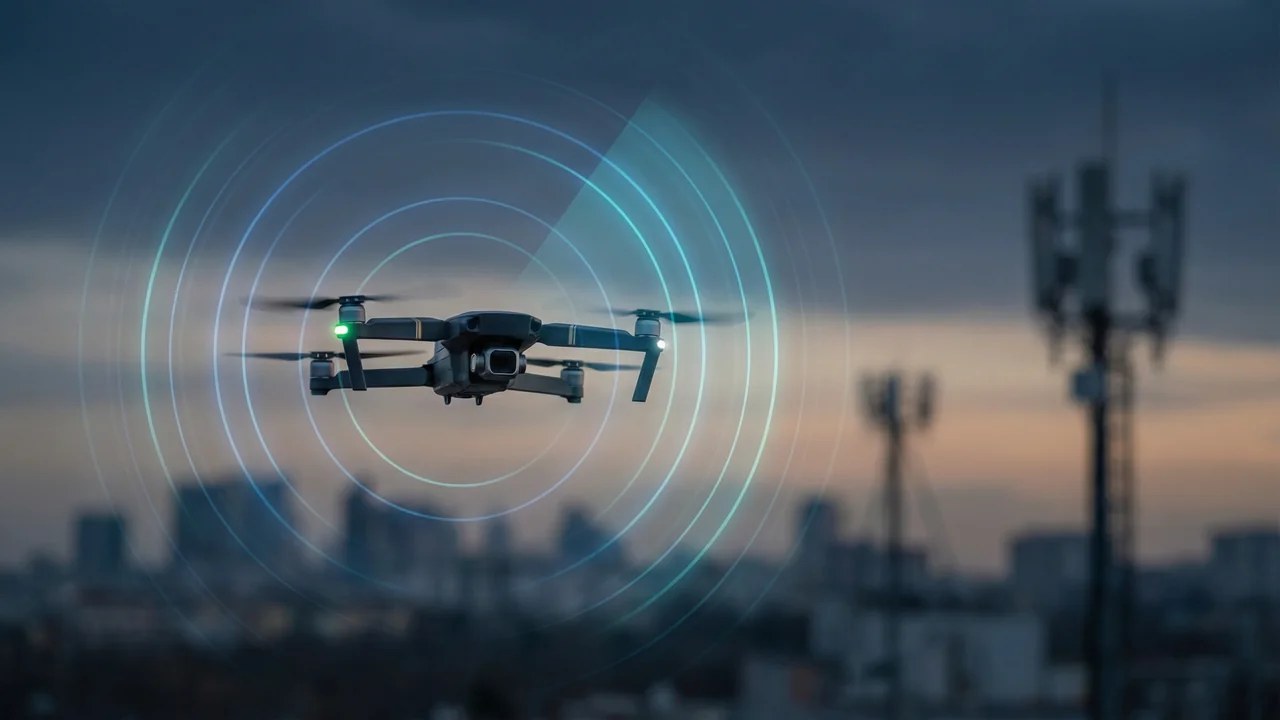
The major innovation presented by Ericsson is based on ISAC (Integrated Sensing and Communication) technology. Specifically, this advancement allows the radio waves emitted by massive-MIMO 5G antennas to be used not only for communication but also for the spatial detection of passive objects.
Unlike traditional systems that require a drone to be connected to the network or emit an identifiable signal, ISAC operates on the principle of echolocation, much like radar or a bat's sonar. Radio waves bounce off physical objects, allowing the network to detect, locate, and track drones in real-time—even if they are flying autonomously without a SIM card or active connection.
During a full-scale demonstration at its U.S. headquarters in Plano, Texas, in late February 2026, Ericsson proved that this technology is now operational. The competitive advantage is significant: it eliminates the need to deploy costly and complex dedicated radar networks. Operators can leverage existing mobile infrastructure, providing vast coverage and the ability to "see around obstacles" in dense urban environments.
A Direct Response to the Security Crises of 2025
The urgency of deploying such solutions has never been more pressing. The year 2025 was marked by a dark series of drone-related incidents in Europe. In September 2025, unexplained flyovers forced the temporary closure of major airports, including Copenhagen, Oslo, Munich, and Bremen, paralyzing air traffic and affecting tens of thousands of passengers. Military bases and nuclear sites in France, Germany, and Belgium were also targeted by unidentified drone swarms.
These events exposed critical gaps in low-altitude airspace surveillance. Classic counter-drone systems—jammers, optical radars, RF detection—often struggle to cover large areas continuously and economically. Ericsson’s ISAC solution, by turning every cell tower into a sensor, offers a dense and permanent territorial grid, ideal for protecting airports, sensitive industrial sites, and large crowds at major events.
Notably, Vodafone and the startup Tiami Networks presented a similar demonstration at Mobile World Congress 2026 (MWC26), proving that ISAC can function on existing Open RAN networks without disrupting ongoing communications. Meanwhile, Samsung is already integrating this technology into its 5G Advanced and 6G roadmaps. The convergence of these major players around ISAC confirms that this technology is set to become an industry standard.
Europe Taking Action: The Commission's Strategic Plan
Ericsson's demonstration aligns perfectly with the new European security strategy. On February 11, 2026, the European Commission unveiled an ambitious action plan on security and the fight against malicious drones, presented by Commissioner Henna Virkkunen.
Among the plan’s key measures is the specific use of cellular networks for detection. The Commission intends to launch calls for expressions of interest to encourage Member States and the industry to test and deploy detection via 5G antennas. The goal is to create a unified aerial display system, aggregating data to instantly differentiate legitimate drones (delivery, inspection) from potential threats.
This political momentum is accompanied by major economic stakes. The European counter-drone market is exploding, with growth forecasts exceeding 27% per year, projected to reach over $4 billion by 2030. By leaning on players like Ericsson, Vodafone, and Samsung, Europe seeks to reduce its technological dependence on non-EU solutions and build sovereign capabilities.
Toward 6G and Artificial Intelligence
While ISAC technology is proving its worth on 5G Advanced networks today, it is already considered a fundamental pillar of the upcoming 6G standard, slated for 2030. The integration of Artificial Intelligence at the heart of these networks (AI-on-RAN) will further refine detection by analyzing flight patterns to predict a suspect drone's intent and automatically trigger mitigation protocols.
The convergence of telecommunications and radar detection marks a turning point. By transforming our mobile networks into invisible shields, companies like Ericsson are providing a pragmatic, scalable, and economically viable response to one of the most complex security threats of our decade. For security professionals and infrastructure managers, integrating 5G into counter-drone strategies is no longer a futuristic option—it is an operational reality to be seized today.
Sources: Ericsson Press Release (February 26, 2026), European Commission Action Plan on Drone Security (February 11, 2026), Vodafone MWC26 (February 26, 2026), MarketsandMarkets — Europe Anti-Drone Market Report 2025.
Cookie Settings
We use cookies to optimize your experience, analyze our traffic, and personalize content. To learn more, see our privacy policy.