
Drone Training Prices in 2026: Rates, Funding, and CPF | Dronexperts
Dronexperts
Company
How much does professional remote pilot training cost? Discover average market rates, cost breakdowns, and how to secure 100% funding via CPF, France Travail, or OPCO.
Drone Training Prices in 2026: Rates, Funding, and CPF
It is often the first question we are asked over the phone: "How much does it cost to become a drone pilot?"
And it is a fair question. Embarking on a new career path or professional retraining is a significant investment. However, when browsing the internet, you will find everything from "express" courses for a few hundred euros to comprehensive programs costing several thousand.
Why such a gap? What justifies the price? And most importantly, how can you avoid paying out of pocket? At Dronexperts, we believe in full transparency. Here is everything you need to know about budgeting for your drone career in 2026.
What Makes Up the Price of Training?
Quality training is not just about access to a classroom. When you pay for a certifying course, the price covers essential technical costs to guarantee your safety and the quality of your learning:
- High-End Equipment: We do not train you on toys. You will fly professional-grade aircraft (DJI Mavic 3 Enterprise, Matrice 300/350 RTK, etc.). These drones cost several thousand euros and require rigorous maintenance and batteries (which are expensive consumables).
- Insurance: Every student flight is covered by specific aeronautical civil liability insurance.
- Qualified Instructors: Our trainers are not just "pilots"; they are expert educators with real-world field experience.
- Flight Grounds: Access to secure, declared flight zones that comply with DGAC (French Civil Aviation Authority) requirements.
Dronexperts Tip: Beware of "low-cost" 100% online offers. Drone piloting is a manual skill. You cannot learn to fly effectively just by watching YouTube videos, any more than you can learn to drive a car by watching Netflix.
Average Price Ranges in France (2026)
While every training center is free to set its own rates, here are the market averages for serious, professional training:
1. Theoretical Preparation (A2/CATS)
- E-learning Option (Self-paced): Between €150 and €400.
- In-person Option (With instructor): Between €500 and €900.
- Dronexperts' Take: E-learning is sufficient if you are highly disciplined. In-person is recommended if you need interaction to understand complex regulations.
2. Practical Training (STS Scenarios)
This is the core of the profession. Duration usually varies from 3 to 5 intensive days.
- Average Rate: Between €1,200 and €2,500. This price varies depending on the student-to-instructor ratio (at Dronexperts, we keep groups small to maximize flight time).
3. Specializations (Photogrammetry, Thermography)
These advanced modules require expensive software and high-level expertise.
- Average Rate: Between €1,000 and €2,000 per specialization module.
The Good News: How to Secure 100% Funding
In France, professional training is very well supported. In the majority of cases, our students do not fund their training with their own personal savings.
1. CPF (Personal Training Account)
If you have worked in France, you have accumulated training rights. Drone pilot training is eligible for the CPF because it leads to a registered professional certification (RS).
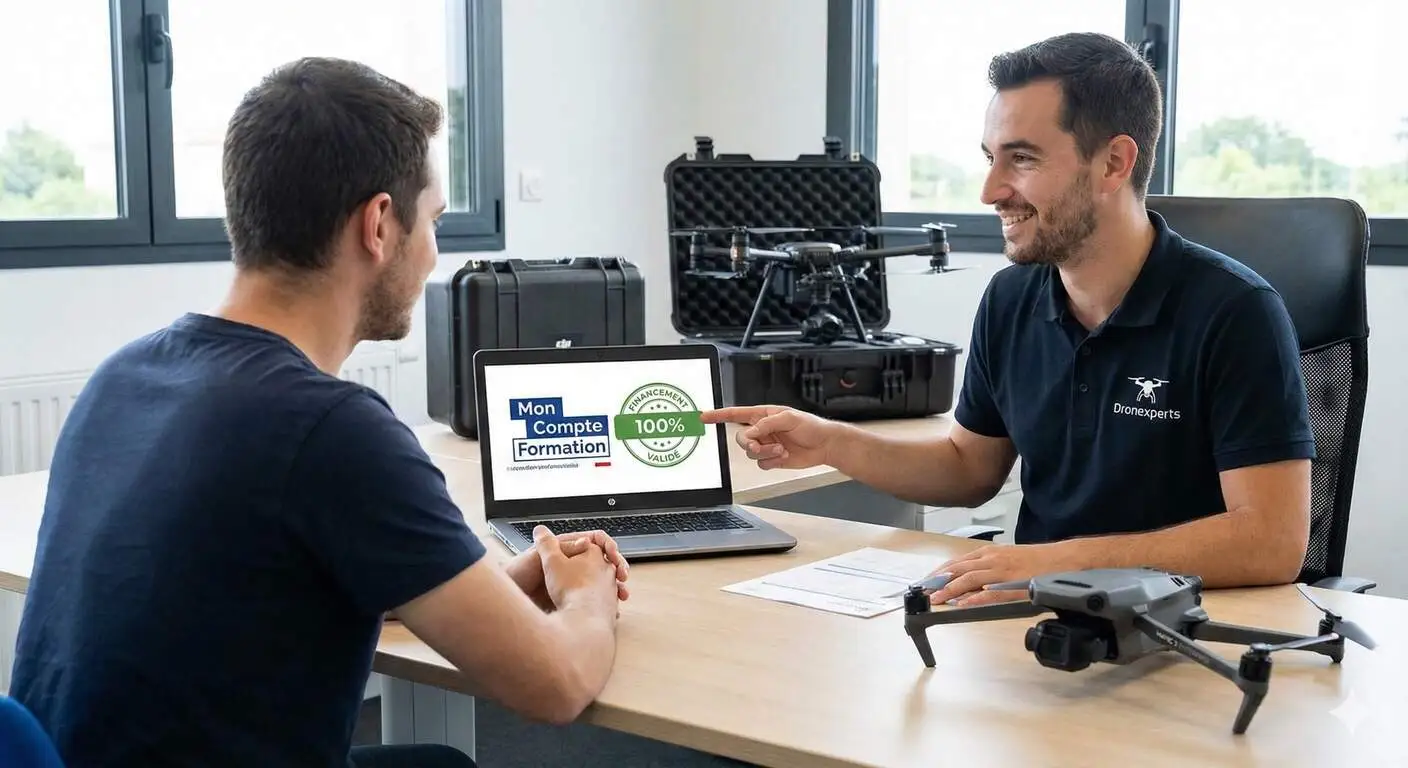
- How to do it? Log in to MonCompteFormation, search for "Dronexperts," and check your balance. You can register in just a few clicks.
2. France Travail (Formerly Pôle Emploi)
If you are a job seeker, you can request AIF (Individual Training Assistance). If your professional project is solid (business creation, job offer), your advisor can approve full funding. We provide the necessary quotes and training plans to support your application.
3. OPCO (For Employees)
If you are an employee and your company wants to train you in drone operations (e.g., for roof inspections in a construction firm or for media in a marketing agency), your company's OPCO (Skills Operator) covers the cost. It costs the employee nothing, and often nothing for the company either.
4. FAF (For Freelancers / Self-Employed)
Craftsmen and independent professionals contribute to a Training Insurance Fund (FAF like AGEFICE, FIF PL, FAFCEA). You have an annual budget for training—don't let it go to waste!
Conclusion: Investing to Earn
Do not view the price of training as an expense, but as an investment. A professional remote pilot charges between €400 and €1,500 per day depending on their technical specialty. Therefore, quality training pays for itself very quickly.
Don't stay in the dark. Every situation is unique.
Do you want to know if you are eligible for 100% funding? Our administrative team will handle the application process for you.
[👉 Request my personalized quote and check my eligibility]
Cookie Settings
We use cookies to optimize your experience, analyze our traffic, and personalize content. To learn more, see our privacy policy.