
Class C0 and C1 Drones: Do You Really Need Training? (2025 Guide)
Dronexperts
Company
Drones under 250g (C0) or 900g (C1) seem accessible without a license. Watch out for the traps! Overflight rules, prohibited zones, and risks: here is what you need to know before taking off.
Class C0 and C1 Drones: Do You Really Need Training?
They have been the stars of drone sales in recent years. With the DJI Mini series (Mini 2, Mini 3, Mini 4 Pro) and more recently the DJI Neo, drones weighing less than 250 grams have taken over the skies.
The marketing argument is hard to beat: "No license, no constraints—fly immediately."
The result? Many beginner pilots mistakenly believe that these "small" drones are considered toys and that no rules apply. This is a misconception that can prove costly—resulting in fines, confiscation, or accidents.
At Dronexperts, we far too often see pilots coming for training after they have crashed their first drone or had a major scare. So, for Classes C0 and C1, is training truly unnecessary? Let’s set the record straight.
Class C0 (< 250g): Freedom... with Supervision
This category includes drones weighing less than 250 grams (e.g., DJI Mini 4 Pro, Autel Nano).
What the law says: Indeed, European regulations are flexible. To fly a C0 drone:
- ❌ You have no obligation to pass the online exam on AlphaTango (though it is strongly recommended).
- ✅ You must read the user manual.
- ✅ You must register as an operator on AlphaTango if the drone has a camera (which applies to 99% of models).
The "Overflying People" Trap: It is often said: "With a Mini, I can fly over people." This is true, but with a vital nuance. Overflying uninvolved persons is allowed, but it must not be sustained. Above all, overflying assemblies of people is strictly forbidden. Markets, concerts, sporting events, crowded summer beaches: the answer is NO, even with a 249-gram drone.
Class C1 (< 900g): The Right Compromise?
This category covers slightly heavier drones (up to 900g), such as the DJI Air 3 or the Mavic 3 Classic. They often offer better wind resistance and superior optics compared to C0 models.
What the law says: Here, the rules tighten slightly:
- ✅ Mandatory Training: You must pass the "Open Category A1/A3" theoretical exam on AlphaTango (40 questions).
- ✅ Remote ID: Your drone must broadcast its electronic identification signal, which is automatic on updated C1-certified models.
Limits: As with C0, you can fly in sub-category A1 (near people). Overflying individuals is allowed if it is unintentional and must be terminated as quickly as possible.
Risks Ignored by Beginners (Why Train?)
If the law does not mandate practical training for these lightweight drones, why spend money at Dronexperts?
Because legality and safety are two different things. Here are three realities the user manual won't teach you:
1. Prohibited Zones (Weight Changes Nothing)
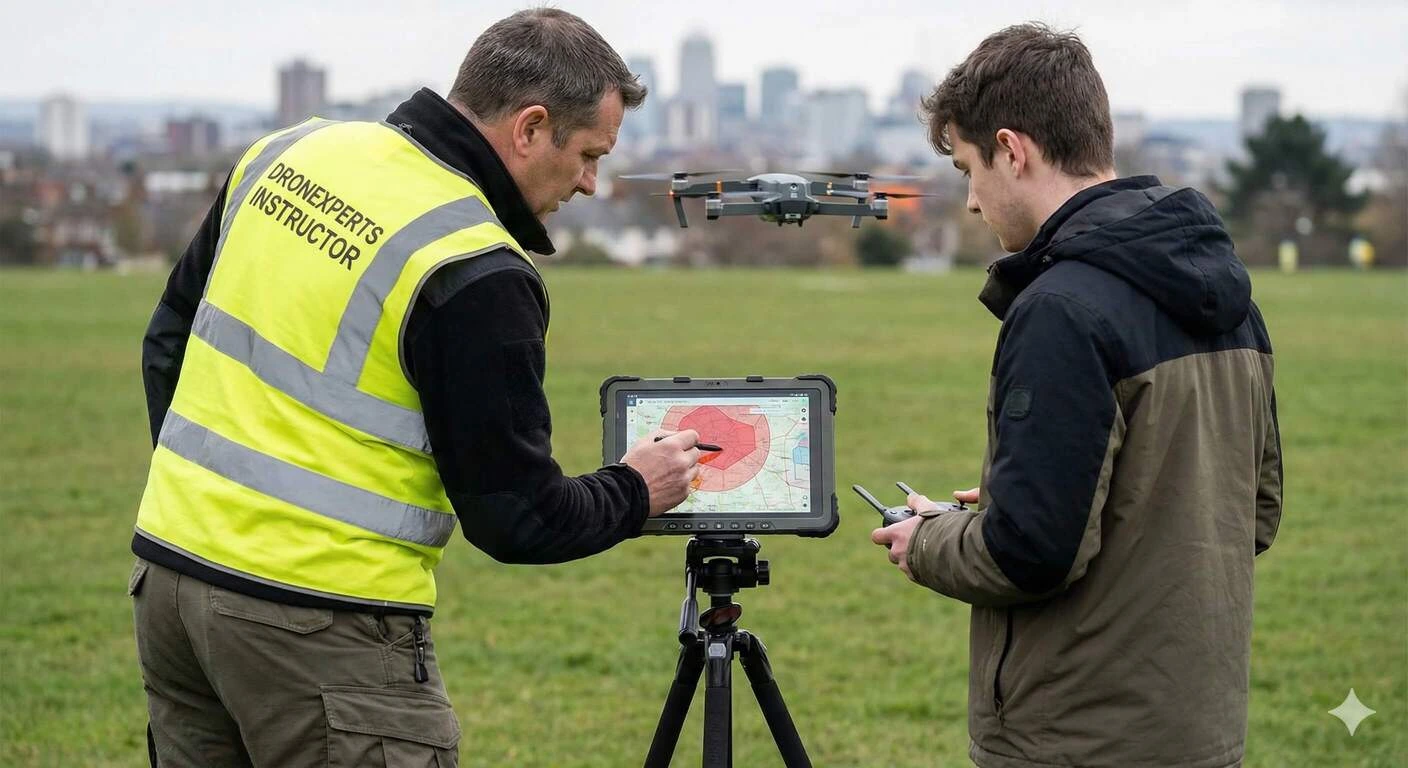
This is the #1 point of confusion. A Prohibited zone (P) or a Restricted zone (R) on an aeronautical map applies to all aircraft. Whether your drone weighs 200g or 10kg, it is strictly forbidden to fly:
- Over public spaces in urban areas (unless you have professional authorization).
- Near airfields and airports.
- Over nuclear power plants or military sites.
- Within national parks. Ignoring these rules can lead to fines of up to €75,000 and 1 year in prison, even with a Mini.
2. Technical Mastery Against the Elements
A Class C0 drone is light. Very light. Once winds exceed 30 or 40 km/h, piloting becomes complex. If you lose GPS signal (which happens in deep valleys or near metal structures), the drone switches to "ATTI" (Attitude) mode and drifts with the wind. Without practical training, 90% of beginners panic and end up in a tree or a wall. Our training courses teach you how to handle these emergencies.
3. Respect for Privacy
Filming a neighbor's pool because "the drone is small" is an invasion of privacy (Article 9 of the Civil Code and 226-1 of the Penal Code). Knowing how to frame shots to respect the law while producing beautiful images is a professional skill.
Conclusion: Don't Leave €1,000 to Chance
Buying a C0 or C1 drone is an excellent choice for starting out. But do not make the mistake of thinking it is a harmless toy.
At Dronexperts, we offer short "Hands-on Introduction" modules (1/2 day or 1 full day). Our goal?
- Configure your safety settings (RTH, max altitude).
- Understand where you are legally allowed to fly.
- Learn to pilot without GPS assistance.
Investing a few hours in training is the best insurance to keep your drone—and your civil liability—intact for years to come.
[👉 Discover Dronexperts introductory training courses]
Cookie Settings
We use cookies to optimize your experience, analyze our traffic, and personalize content. To learn more, see our privacy policy.