
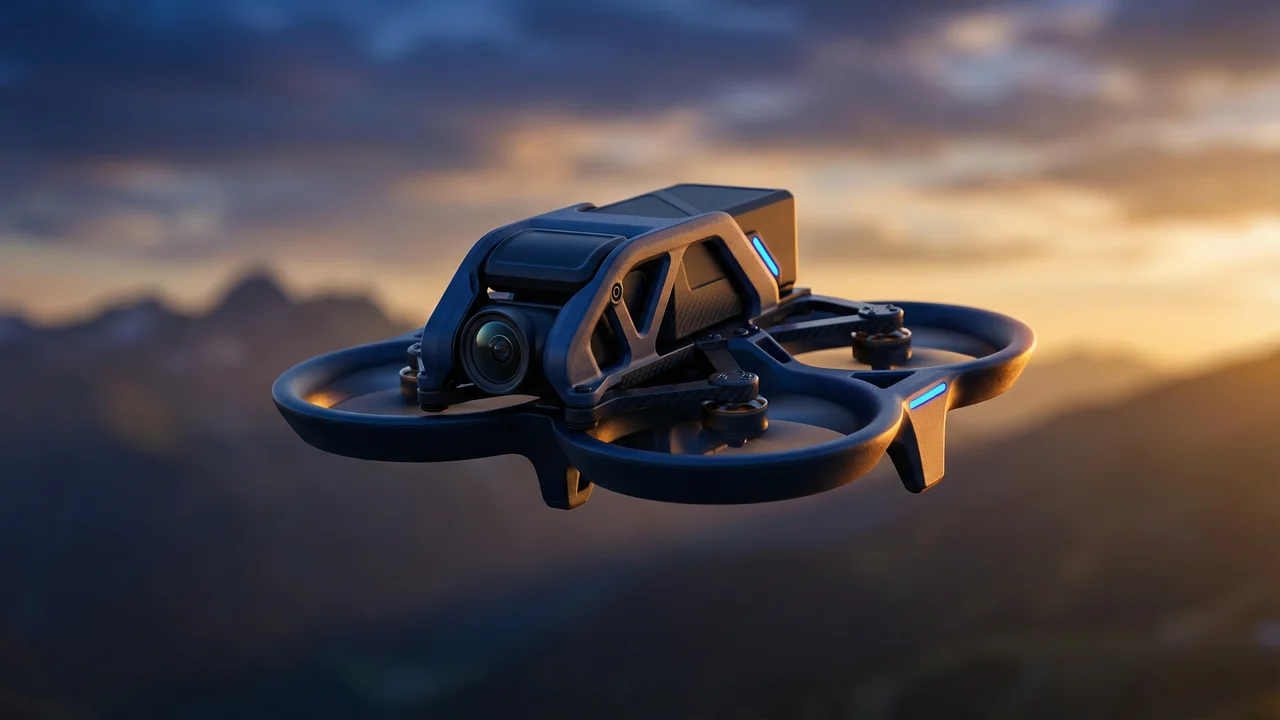
DJI Avata 360 Full Review: The New King of 360° FPV Drones in 2026
Dronexperts
Company
Discover our comprehensive review of the DJI Avata 360. Specs, pricing, 8K video quality, and a head-to-head with the Antigravity A1. Is it the must-have drone of 2026?
The year 2026 marks a decisive turning point in the world of aerial capture. With the long-awaited launch of the DJI Avata 360, the Chinese giant is directly tackling a new market segment: FPV drones equipped with 360-degree cameras. Previously dominated by Insta360's initiatives (notably through its Antigravity subsidiary and the A1 model), this sector is now seeing the arrival of a heavyweight competitor.
This new model promises to merge the immersive flight experience of the Avata range with the infinite creative possibilities of spherical video. But beyond the marketing hype, how does the DJI Avata 360 actually perform in the field? Is it truly the new essential tool for content creators and FPV pilots? Let’s dive into the heart of this technological revolution.
High-Flying Technical Specifications
The DJI Avata 360 doesn't just recycle the chassis of its predecessors with a new camera attached. It entirely reimagines the FPV capture approach.
Dual Supercharged CMOS Sensors
At the core of the innovation is a brand-new camera block featuring two 64-megapixel 1/1.1-inch CMOS sensors, each offering a 200° field of view (FOV). This setup allows for breathtaking spherical video recording in 8K at up to 60 frames per second. For imaging professionals, the integration of the 10-bit D-Log M color profile ensures an extended dynamic range, ideal for post-production grading. The maximum bitrate reaches 180 Mbps, ensuring exceptional detail richness.
An interesting feature: during takeoff, the gimbal pivots 90 degrees to point the lenses up and down, making the drone virtually "invisible" in the video sphere thanks to a remarkably efficient stitching algorithm.
O4+ Transmission and Enhanced Safety
On the radio link side, DJI deploys its proprietary O4+ (OcuSync 4 Plus) technology. The video feed in the goggles runs at 1080p at 60 fps (and up to 100 fps in single-lens mode), with a 60 Mbps bitrate. While the latency is slightly noticeable, it remains low enough to guarantee precise and responsive piloting.
Safety hasn't been overlooked. The Avata 360 leverages its spherical cameras, coupled with ToF and LiDAR sensors at the front, to offer omnidirectional obstacle detection. Although avoidance can be disabled for more aggressive flights (especially in Manual/Sport mode), this assistance will reassure pilots navigating complex environments.
The Ultimate Immersion: Head Tracking
One of the major strengths of this drone lies in its piloting ecosystem. Paired with the DJI Goggles 3 (or N3) and the RC Motion 3 joystick, the Avata 360 offers an intuitive interface accessible even to beginners.
However, the real magic happens when you activate the Head Tracking function. In this mode, your head movements virtually orient the camera within the 360° sphere. You can look sideways, up, or down, independently of the drone's trajectory. The sensation of being literally seated in the cockpit is stunning and completely redefines the immersive flight experience.
Image Quality and Post-Production with DJI Studio
Filming in 360 degrees inevitably involves a post-production stage to fully utilize the footage. This is where the DJI Studio software comes in.
The Stitching Challenge
The assembly of the two video hemispheres (stitching) is generally outstanding. The propellers and bulky guards disappear entirely from the final image. However, as is common with this technology, artifacts can appear when objects are very close (less than 2 meters) to the lenses. Beyond this safety distance, the illusion is perfect.
Reframing and Creativity
DJI Studio allows you to transform your spherical videos into traditional "flat" sequences. You can set keyframes to create smooth virtual camera movements, automatically follow a subject, or generate spectacular effects like the "Little Planet." While time-consuming, this process offers unparalleled creative freedom: you film first, and you frame later.
DJI Avata 360 vs. Antigravity A1: Clash of the Titans
Comparison with the Antigravity A1 (Insta360 subsidiary) is inevitable. While the A1 paved the way, the DJI Avata 360 appears to take the lead on several crucial points:
| Feature | DJI Avata 360 | Antigravity A1 |
|---|---|---|
| Max Video Resolution | 8K at 60 fps | 8K at 30 fps |
| Sensors | 2x CMOS 1/1.1" | 2x CMOS 1/2" |
| Goggle Feed | Smooth (Cropped view) | Choppy (Full 360 view) |
| Base Price (Drone only) | €459 | > €800 |
| Ecosystem | Goggles 3 / RC Motion 3 | Proprietary Vision Headset |
DJI's pricing is particularly aggressive. Offered at €459 standalone, and €939 for the Motion Fly More pack (including Goggles N3 and RC Motion 3), the Avata 360 is significantly more affordable than its direct competitor, especially for pilots who already own recent DJI gear.
Regulation: What You Need to Know in Europe
Despite its imposing look, the DJI Avata 360 achieves a regulatory feat. With a Maximum Take-Off Mass (MTOM) fixed at 455 grams (including battery), it earns a Class C1 certification.
In Europe, this means it can be operated in the Open category, sub-category A1. It is therefore possible to fly over residential or commercial areas (excluding public spaces in urban centers), provided you have completed the A1/A3 online training. Be careful, however: FPV flight always requires the presence of a visual observer by your side.
Conclusion
The DJI Avata 360 is not just a simple update; it’s a new value proposition. By combining the ease of flight of the Avata series with the creative power of 8K 360° video, DJI has delivered a formidable tool for content creators.
If you are looking for a drone for standard "ready-to-use" shots, look elsewhere. However, if you are willing to invest time in post-production to achieve impossible angles and breathtaking virtual camera movements, the Avata 360 is undoubtedly the best choice on the market in 2026.
Ready to push the limits of your creativity? Make sure to check your current hardware compatibility and get ready to rediscover the world from every angle!
Cookie Settings
We use cookies to optimize your experience, analyze our traffic, and personalize content. To learn more, see our privacy policy.