
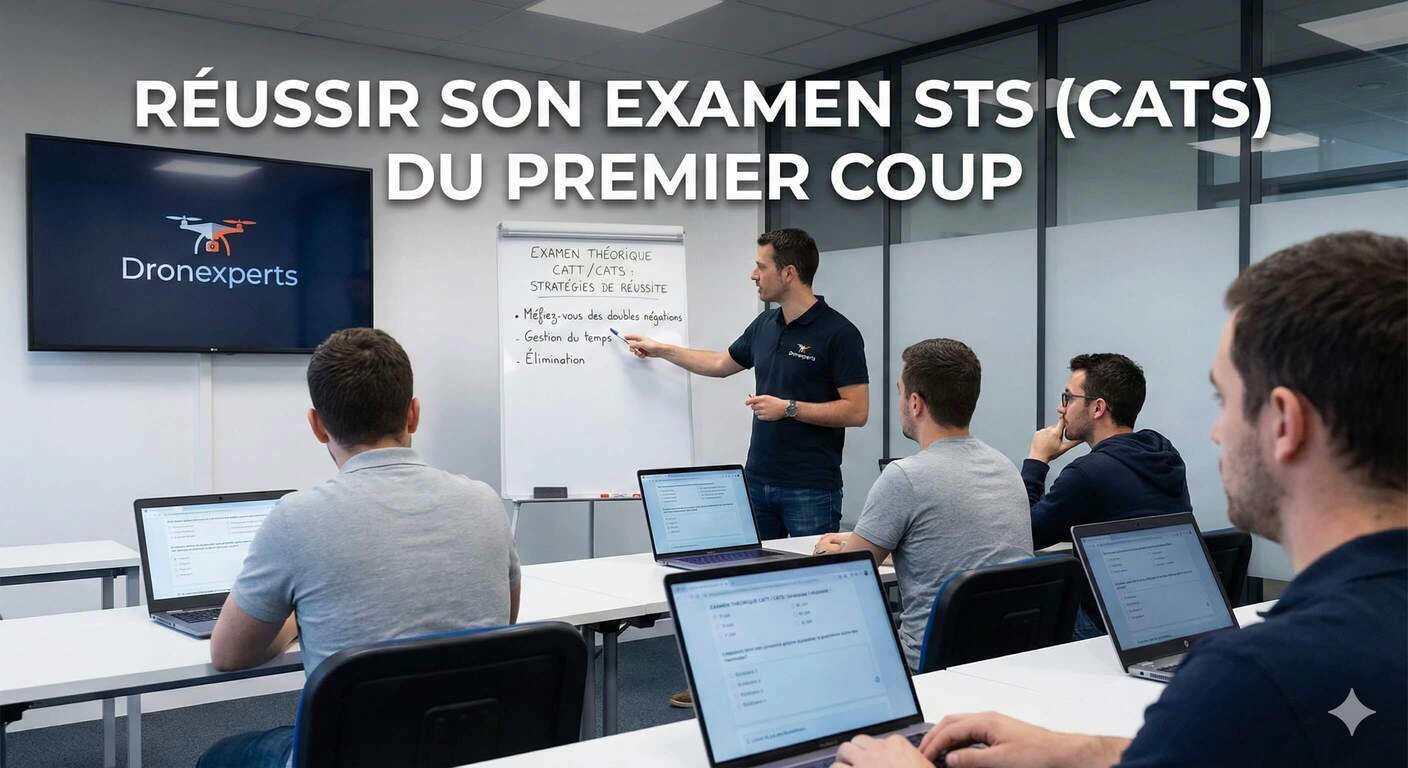
CATT and CATS Exams: How to Pass Your Drone Theory Test on the First Attempt?
Dronexperts
Company
Tips, study methods, and traps to avoid to obtain your Remote Pilot Theoretical Knowledge Certificate for STS (CATS). Don't let the multiple-choice test hold back your professional career.
STS (CATS) Exam: How to Pass Your Drone Theory Test on the First Attempt?
You’ve bought the gear, you’ve read the manuals, you know how to fly... but one major hurdle remains before becoming a professional drone pilot: the theory exam.
Often dreaded, sometimes underestimated, this exam is nevertheless a mandatory step for operating in the Specific category (STS Scenarios). And let's be honest: the failure rate is very real. Many candidates arrive "with stars in their eyes," thinking that knowing their drone is enough to succeed. This is a mistake. The exam focuses on aeronautics, not just the "On/Off" button on your remote controller.
At Dronexperts, we prepare hundreds of students for this test. Here is our expert advice to stack the odds in your favor and pass your exam on the first try.
CATT vs. CATS: What’s the Difference?
Before you start studying, you need to know what you are taking. In 2026, the European transition introduced new terms that can be confusing.
- CATT (Certificat d'Aptitude Théorique de Télépilote): This was the historical French national exam. Today, it is being gradually replaced or recognized through equivalence.
- CATS (Certificat d'Aptitude Théorique pour les Scénarios standard): This is the new reference exam for operating under European STS-01 and STS-02 scenarios.
What to expect: The exam takes place at a DGAC (French Civil Aviation Authority) center on a computer.
- It is a 40-question multiple-choice test.
- You have 1 hour to complete it.
- You must achieve a 75% pass mark (30/40) to validate the exam.
Key Topics to Master
Don't expect to pass by just skimming the surface. The syllabus is dense and covers complex concepts from manned aviation.
Here are the 4 pillars of the curriculum:
- Aviation Regulation (The biggest piece): This is often where points are lost. You must know by heart the airspace classes (A, B, C, D, E, F, G), the rules of the air (SERA), and the specifics of European regulations 2019/947 and 2019/945.
- UAS General Knowledge: LiPo battery operation, Command and Control (C2) link principles, sensors, and maintenance.
- Meteorology: Knowing how to read a METAR or a TAF, understanding breeze phenomena, air density, and the impact of temperature on lift.
- Human Performance and Risk Mitigation: Managing fatigue, visual perception, the effects of alcohol/medication, and ground and air risk management (SORA).
5 Tips for the Big Day
Studying is one thing; passing the multiple-choice test is another. Here are 5 strategies to gain points on exam day:
1. Beware of Double Negatives
The DGAC loves convoluted phrasing. Example: "It is not prohibited to not..." Take the time to rephrase the question in your head to ensure you’ve understood the meaning. Rushing is the #1 cause of "silly" mistakes.
2. Time Management
You have 1 hour for 40 questions, which is 1.5 minutes per question. This is plenty of time. If you get stuck on a technical question, don’t freeze. Mark it, move to the next, and come back to it at the end. The stress of watching the clock can make you lose your focus.
3. Use the Process of Elimination
Often, out of the 4 answer choices, two are completely absurd or off-topic. Identify and eliminate them immediately. This increases your chances from one-in-four to a fifty-fifty shot at the correct answer.
4. Pay Attention to Units of Measurement
Read the prompts carefully. Are they talking about speed in m/s (meters per second) or km/h? Height (relative to the ground) or altitude (relative to sea level)? A poor conversion equals a lost point.
5. Don't Rely on Luck
Contrary to some myths, there are no "negative points" (a wrong answer doesn't deduct points), but the 75% threshold is high. You cannot afford to guess on more than 3 or 4 questions.
Why Multiple-Choice Apps Aren't Always Enough
There are many apps for "cramming" exam-style questions. While great for practice, be careful: memorizing answers is no longer enough.
Questions evolve, and phrasing changes. If you’ve simply memorized that "the answer is A" for a battery question, you’ll be lost if the question is asked differently on the day.
You must understand the logic. This is where structured theoretical training makes the difference.
At Dronexperts, our instructors don’t just read slides to you. They explain why hot air rises, why a propeller stalls, and how to read an aeronautical chart. We offer:
- In-person sessions for interaction.
- Comprehensive E-learning modules to study at your own pace.
- Corrected and explained mock exams.
Conclusion
Theory is a dry stage, but it will make you a better remote pilot. Once you have this credential in hand, you can focus peacefully on practice and your professional missions.
Don’t let the theory test hold back your career. Prepare with the pros.
[👉 Discover our Remote Pilot Theory preparation module (Pass rate > 90%)]
Cookie Settings
We use cookies to optimize your experience, analyze our traffic, and personalize content. To learn more, see our privacy policy.